How to Find Jeans That Fit
DENIM FIT GUIDE
A calm, practical guide to understanding jean shape, rise, waistband, fabric, length and the details that make denim fit, feel and look right on your body.
ON THIS PAGE
1. Start with your body shape, not the trend
The biggest mistake women make when shopping for jeans is starting with the trend.
Wide leg. Barrel leg. Skinny. Straight. Flare. Low rise. High rise.
There is always a new denim shape being pushed, but the best jeans for you are not always the newest jeans in store. They are the jeans that work with your body shape, your proportions and your real life.
Your body shape gives you the first clue. It helps you understand where you need structure, where you need softness, and which leg shapes are likely to create balance.
This does not mean you are restricted to one style forever. It simply gives you a starting point, so you are not walking into a denim department and trying on everything.
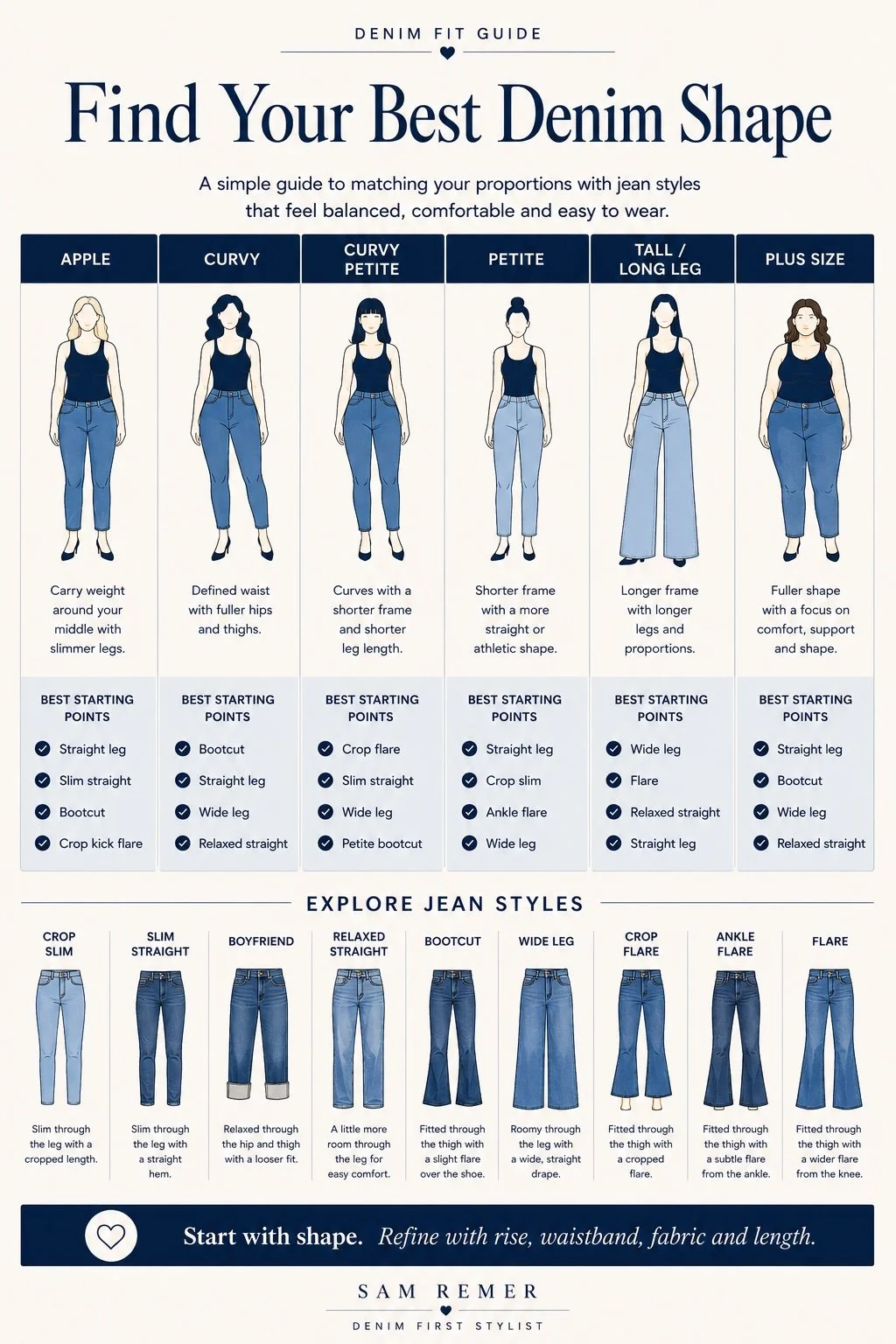
Apple shapes often suit straight leg, slim straight, relaxed skinny, crop kick flare and some bootcuts, depending on where the waistband sits.
Curvy shapes can work beautifully with bootcut, straight leg, wide leg, flare and boyfriend styles, especially when the waist and hip fit is right.
Petite shapes can wear far more leg shapes than they’re often told. Straight, slim straight, cropped kick flare, bootcut and well-proportioned wide-leg styles can all work when the scale and length are right.
Petite curvy shapes need the same attention to proportion, with the added consideration of fitting fuller hips and curves without overwhelming a smaller frame.
Tall and long-leg shapes can often carry a wider range of leg shapes, but rise, inseam and overall proportion still matter.
Plus-size shapes can look fantastic in straight leg, bootcut, wide leg, flare and slim styles. The key is finding a cut that skims your shape rather than making you feel you need to hide under lots of fabric.
Use this as a starting point, not a rulebook. The right rise, waistband, fabric and length still matter.
“The goal is not to label yourself. The goal is to stop blaming your body when the jeans are simply the wrong cut.”
2. Choose the leg shape that gives you balance
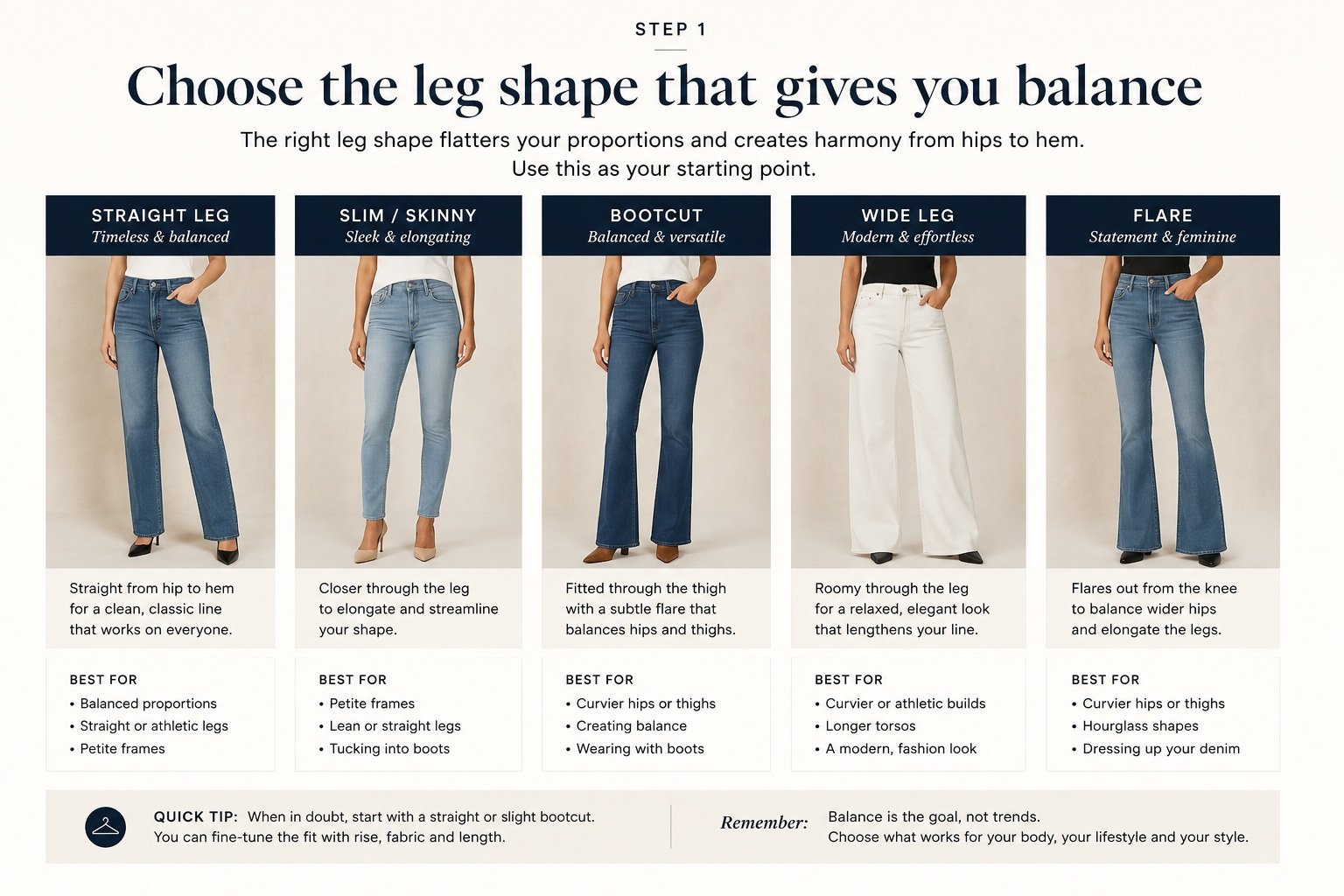
Once you understand your shape, look at the leg of the jeans.
The leg shape changes everything. It affects how your hips, thighs, waist and shoes all work together. A jean can technically “fit” but still not flatter, because the leg shape is pulling the outfit out of balance.
A straight leg is often the easiest place to start because it works for many body shapes and can be styled casually or more polished. Bootcut and flare jeans can be brilliant for balancing hips and creating length. Wide leg jeans can look modern and elegant, but they need the right rise, fabric and shoe. Skinny jeans can still work, especially tucked into boots or worn as part of a longer-line outfit, but they are no longer the only option.
When trying jeans on, ask yourself:
Does this leg shape balance my top half and bottom half?
Does it work with the shoes I actually wear?
Does it make outfit building easier or harder?
Do I feel like myself in it?
A great-fitting jean should not need constant adjusting.
If you’re unsure which leg shape is right for you, take a look at my What Shape Jeans Should I Wear? guide for a full breakdown of the different denim cuts.
3. Understand your rise
Rise is one of the most important parts of finding jeans that fit.
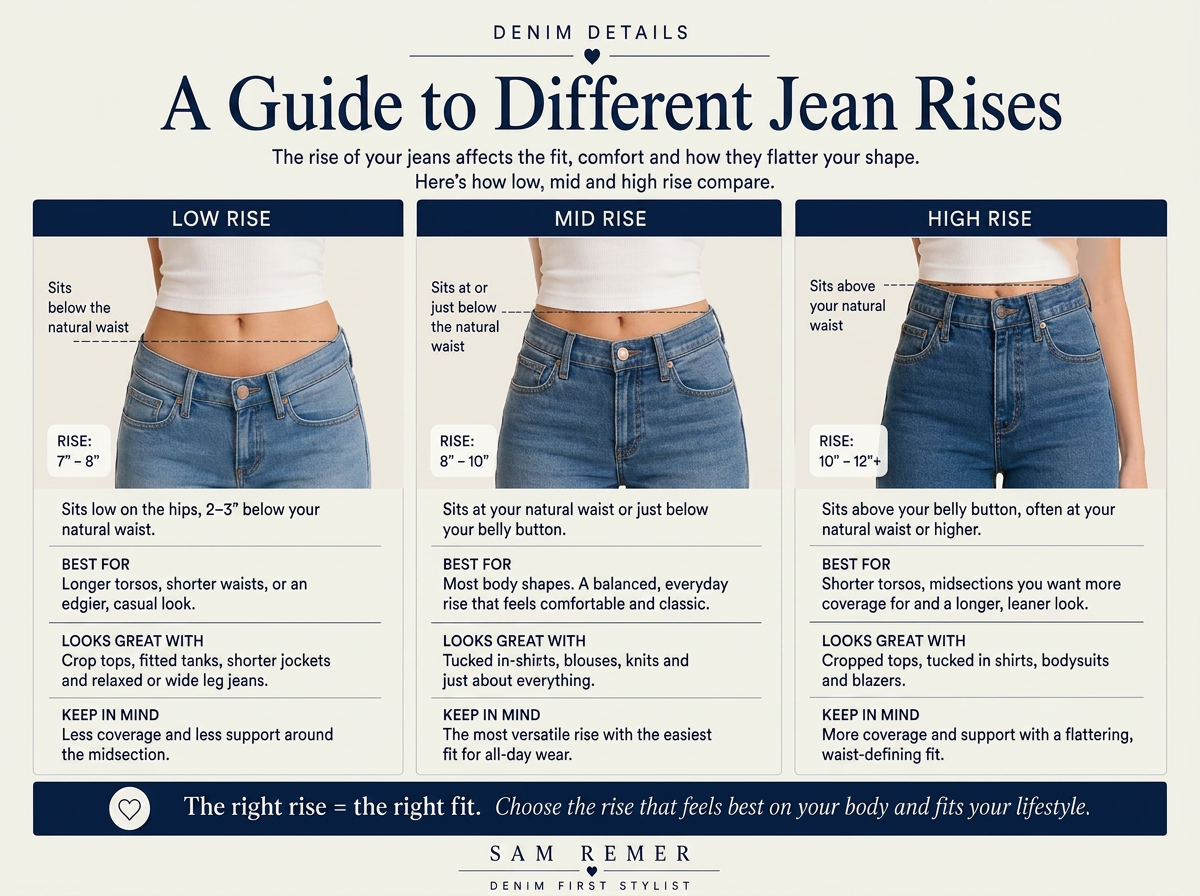
The rise is the measurement from the crotch seam to the top of the waistband. It determines where the waistband sits on your body, and that affects comfort, shape and proportion.
A jean can be the right size but the wrong rise, which is why it may dig in, roll down, gape at the back or feel uncomfortable when you sit.
Low-rise usually sits well below the natural waist. It can work beautifully on some body shapes and proportions, but the key is making sure it sits comfortably and works with the rest of your outfit.
Mid-rise usually sits just below or around the navel. This is often a useful, wearable rise for many women because it gives shape without feeling too high.
High rise sits at or above the navel. It can create a beautiful silhouette and is often helpful for defining the waist, but only if it sits in the right place on your body.
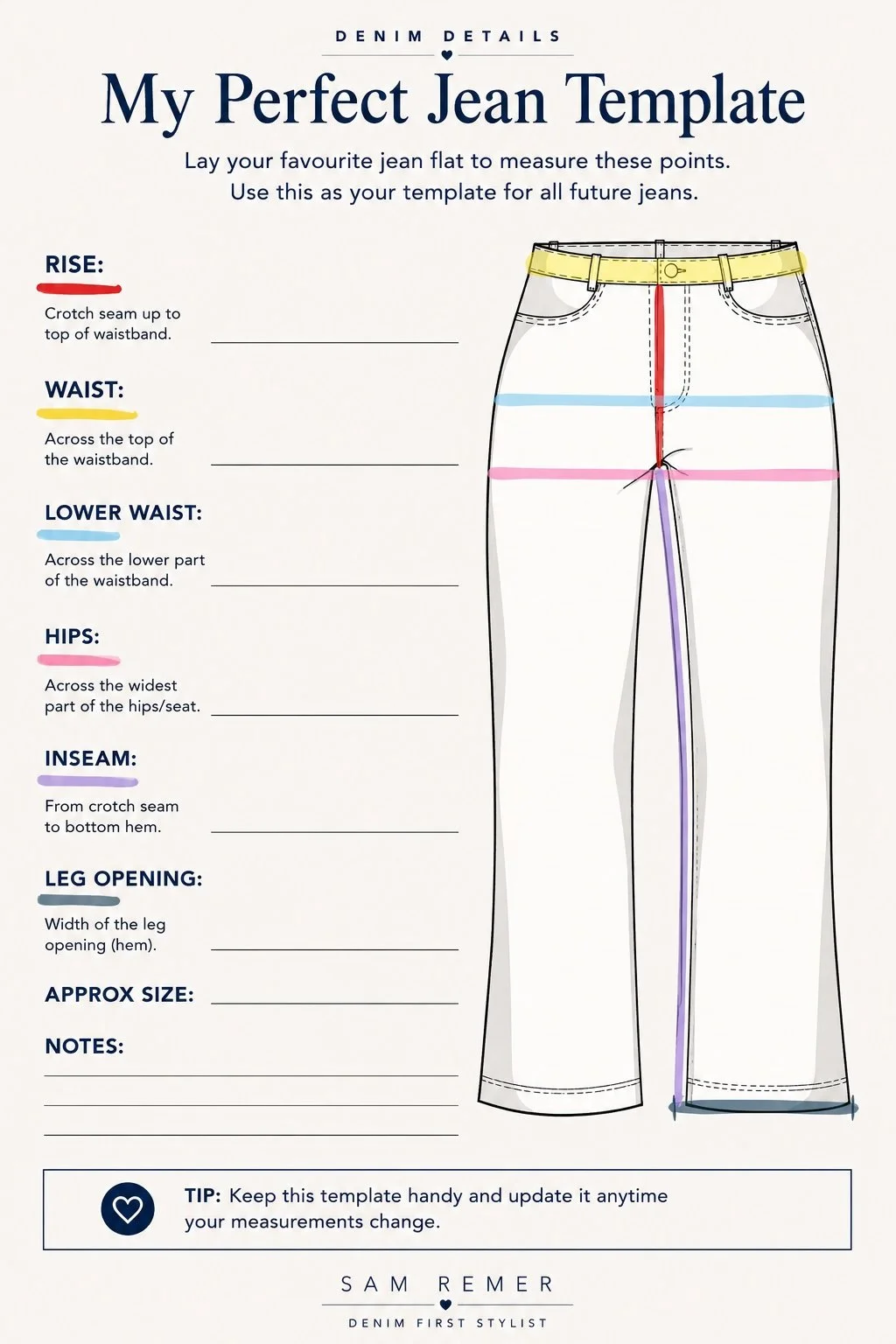
This is why I always recommend learning your own “magic numbers”. If you already own a pair of jeans you love, measure the rise, waist, hip and inseam. Those numbers become your denim template and make future shopping much easier.
You are not looking for a random size. You are looking for the measurements that work on your body.
4. Pay close attention to the waistband
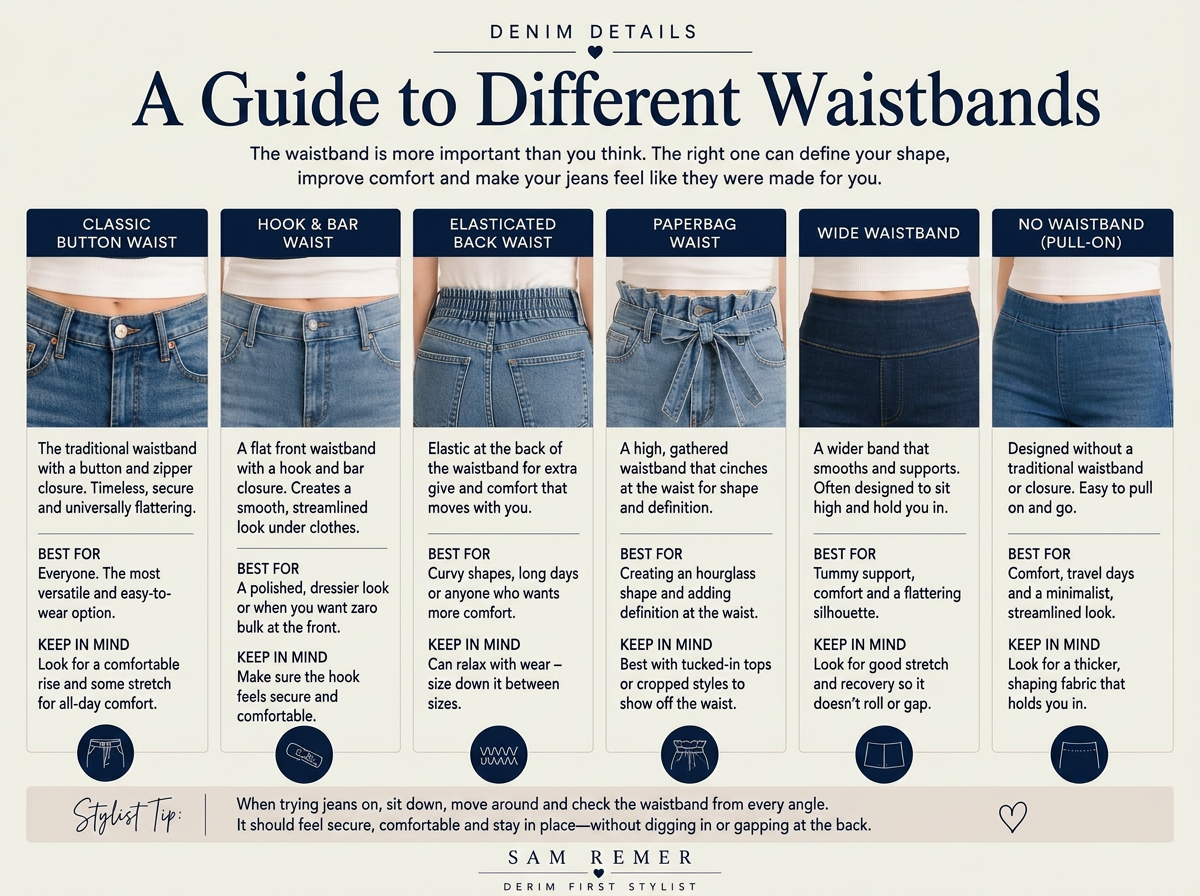
The waistband is where many jeans fail.
If you have a curvier shape, you may find jeans fit on the hips and thighs but gape at the back of the waist. If you carry weight around your middle, you may find the waistband digs in, rolls down or feels uncomfortable when seated.
This is where the construction of the jeans matters.
Look for:
a waistband that sits smoothly without cutting in
enough back rise to give coverage
stretch that supports rather than collapses
a shape that follows your body, not just a straight band of denim
For curvier shapes, a contoured waistband or higher back rise can make a big difference. For apple shapes, the right mid or high rise can feel more secure, but it needs to sit in the correct place and pass the sit test.
Do not judge jeans solely by how they look when standing upright. Sit down. Walk around. Bend slightly. Check whether the waistband still feels like a yes.
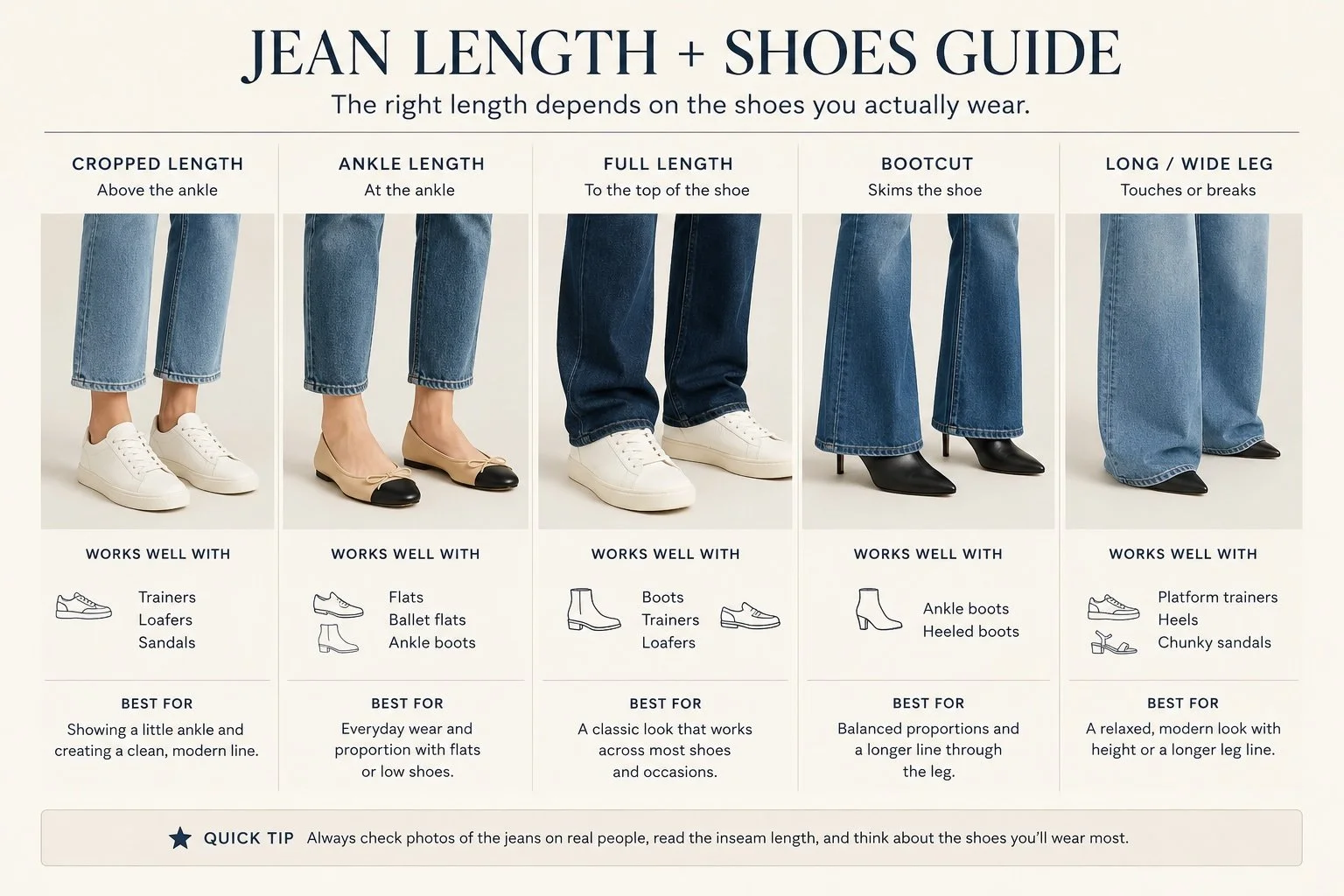
5. Get the length right for your shoes and lifestyle
Jean length is not just a finishing detail. It changes the whole outfit.
Before you decide on length, think about the shoes you wear most. Trainers, ankle boots, loafers, sandals and heels all work differently with denim.
A cropped straight leg may look perfect with trainers and loafers. A bootcut needs enough length to skim over the shoe. A wide leg often needs either a clean cropped length or a longer, more intentional break. An ankle grazer can look polished, but if it hits at the wrong point, it can shorten the leg.
If the jeans fit beautifully everywhere else, do not reject them just because the length is not perfect. Hemming is often simple, and for denim with a special faded or frayed hem, you can ask a tailor to keep the original hem.
A good alteration can turn an almost-right pair into a pair you wear constantly.
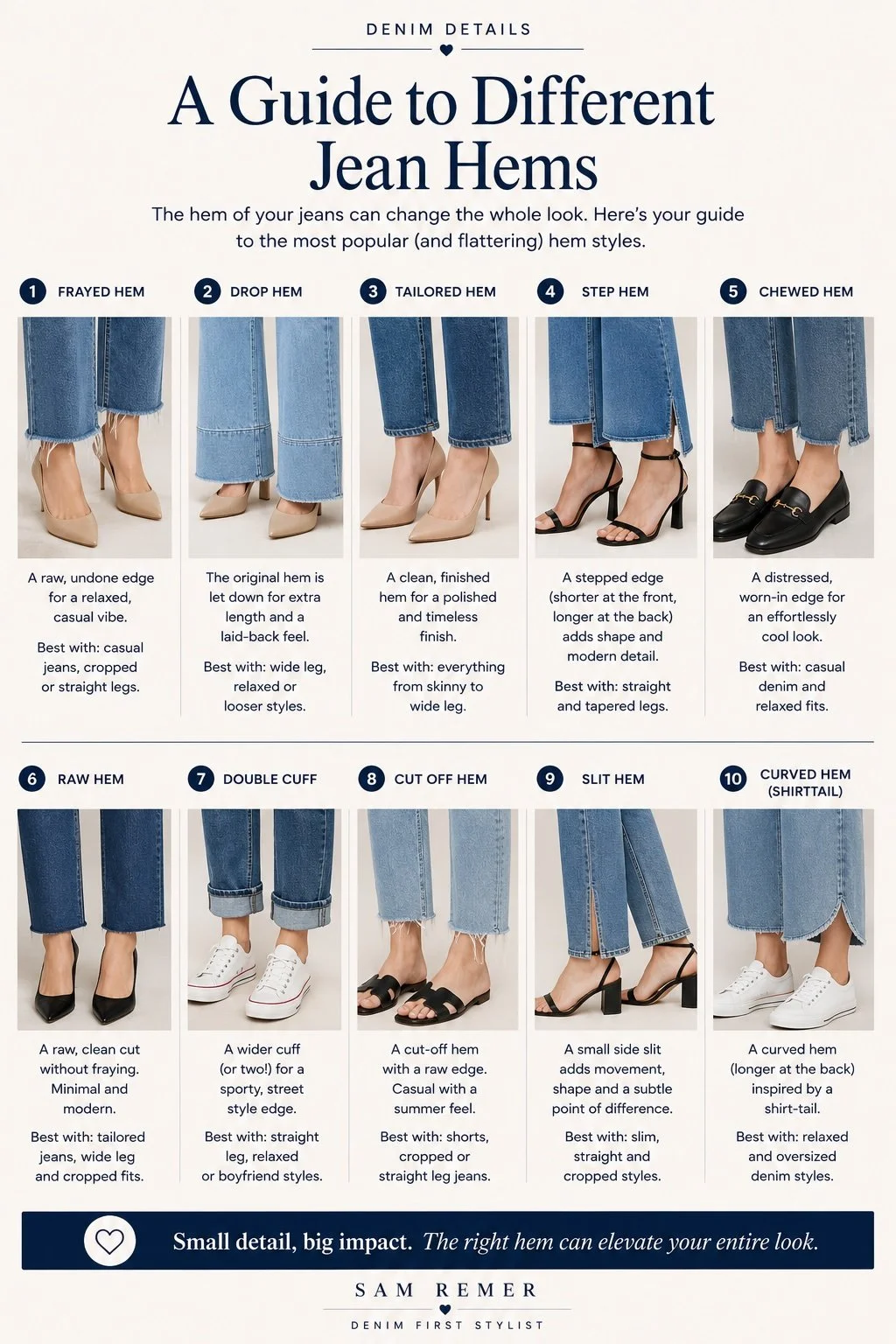
6. Think about the hem
Hems have become part of the style of jeans.
A clean hem feels polished. A frayed hem feels more relaxed. A split hem can work beautifully with ankle boots or heels. A released hem gives a more casual, lived-in feel.
There is no one correct hem. It depends on the style of jean, your shoes and the look you want.
For a more elevated everyday wardrobe, I usually like hems to feel intentional. That might mean a clean tailored hem, a subtle crop, or a frayed hem that looks modern rather than messy.
The question is not just, “Do these jeans fit?”
It is, “Do these jeans work with the outfits I actually want to wear?”
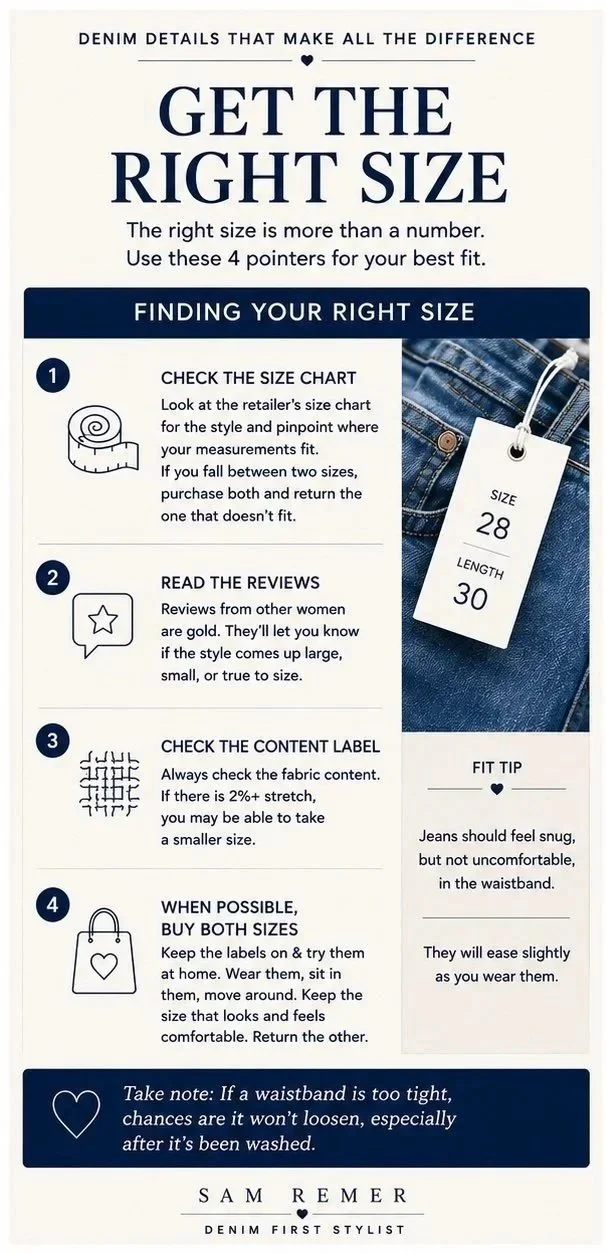
7. Do not get too attached to the size on the label
Denim sizing is inconsistent. Remember this!
You may be one size in one brand, another in a different brand, and a different size in another. This is completely normal.
Some denim brands use generous sizing. Some run small. Some stretch with wear. Some feel firm at first and soften beautifully. Some look good in the fitting room and then bag out after one wear.
The size on the label is just a number. It is not a judgement.
When trying on jeans, take two sizes into the fitting room if you can. If you are buying online, order the two most likely sizes and return what does not work.
The best size is the one that fits your body and keeps its shape, not the smallest number you can wear.
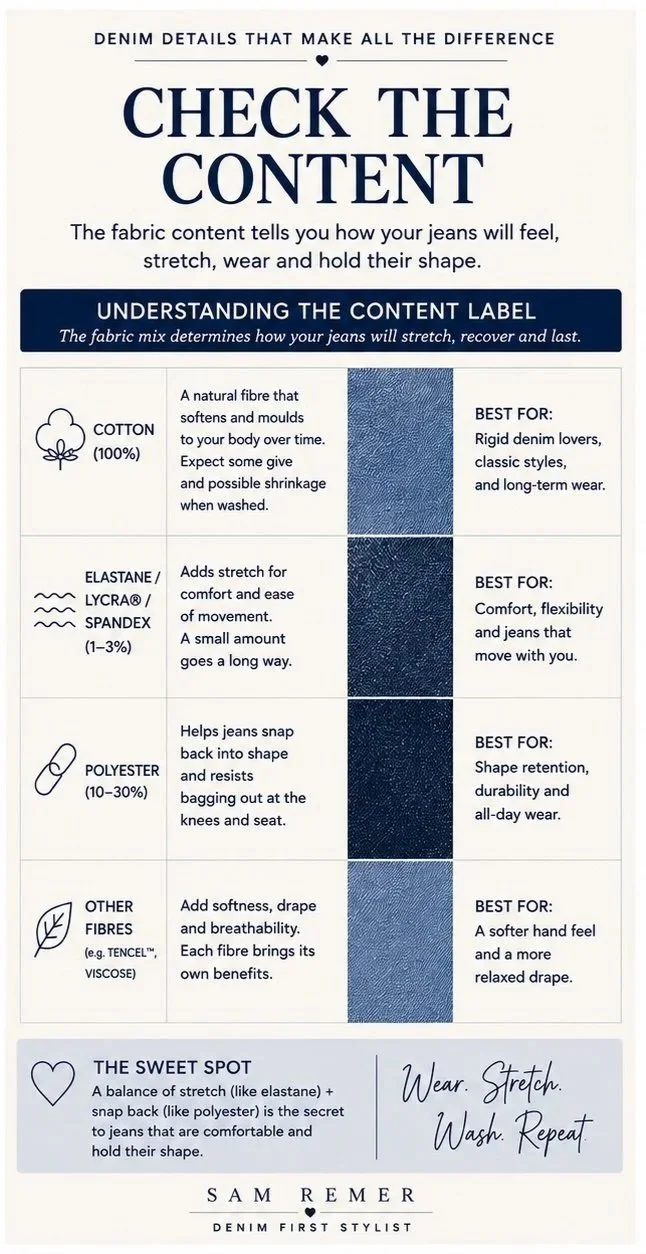
8. Check the fabric and stretch
Fabric content matters because it tells you how your jeans are likely to wear, stretch, wash and recover.
Before you buy a pair of jeans, always check the fabric label. The blend will usually tell you whether the denim is rigid, soft, stretchy, structured or likely to grow with wear.
What does stretch mean in jeans?
Stretch in jeans usually comes from fibres such as Lycra, elastane or spandex. These give denim movement, comfort and flexibility.
But stretch alone is not enough. A jean also needs recovery — the ability to snap back after wear instead of bagging out at the knees, waist or seat.
This is where polyester can help. A small percentage of polyester supports the fabric structure, while elastane, Lycra or spandex gives the jean stretch. Together, they can help denim feel comfortable but still hold its shape.
Do stretch jeans loosen as you wear them?
Yes, stretch jeans often loosen throughout the day. They may feel firm when you first put them on, then relax as you sit, walk and move.
The important question is whether they recover.
A good stretch denim should give you comfort and movement, then return to shape after washing. If the fabric feels very soft, thin or overly stretchy, it may stretch out quickly and lose its shape.
This is why some stretch jeans are best bought slightly snug at first — not uncomfortable, but secure.
Do 100% cotton jeans stretch?
Yes, stretch jeans often loosen throughout the day. They may feel firm when you first put them on, then relax as you sit, walk and move.
The important question is whether they recover.
A good stretch denim should give you comfort and movement, then return to shape after washing. If the fabric feels very soft, thin or overly stretchy, it may stretch out quickly and lose its shape.
This is why some stretch jeans are best bought slightly snug at first — not uncomfortable, but secure.
What is raw denim?
Raw denim is 100% cotton denim that has not been washed or heavily treated at the factory.
It starts firm and structured, then slowly softens and shapes to your body over time. Raw denim usually needs minimal washing, especially in the first few months, so the fabric can develop its own natural wear pattern.
It is a work in progress — beautiful, but not ideal if you want instant softness or easy comfort from day one.
Simple rule: Wear. Stretch. Wash. Repeat.
Your jeans will change as you wear them. The fabric content gives you clues about how much they are likely to stretch, how well they will recover, and whether you should expect instant comfort or a slower break-in process.
One final note: If the waistband feels too tight when you first try the jeans on, chances are it will not loosen enough to become comfortable — especially after the jeans have been washed. A jean can relax through the leg and seat, but the waistband still needs to feel wearable from the start!
9. Use a favourite pair as your denim template
If you already own a pair of jeans you love, use them as your guide.
Lay them flat and measure:
waist
lower waist
front rise
back rise
hip
inseam
leg opening
These are your denim “magic numbers”.
Once you know them, online shopping becomes much easier. You can compare product measurements against jeans you already know work for you.
This is one of the simplest ways to stop guessing.
Instead of asking, “What size am I?” you start asking, “Does this jean match the fit I know works for me?”
That is a much calmer way to shop.
10. Be more intentional when buying jeans online
Buying jeans online can be brilliant, but only if you do it with a plan.
Before you order, check:
The rise measurement
The inseam
The fabric content
The model’s height and size, if available
Reviews mentioning stretch, sizing & fit
Return policy
Whether the cut and fit are likely to work for your shape
If you are unsure, order with the expectation that not everything will work. That is not failure. That is part of the denim process.
The aim is not to keep the first pair you buy. The aim is to learn what works and narrow the search.
If you are constantly ordering and returning without getting clarity, that is usually a sign you need a stronger denim strategy — not more jeans.
11. Where to shop for jeans
The best place to shop depends on your body shape, budget, location and whether you prefer in-store help or online choice.
In London, department stores and dedicated denim departments can be helpful, as you can compare several brands and styles in one place. Selfridges Denim Studio is one of my favourite places to work with clients because there is a strong range of denim brands, and the fitting room process can be focused and efficient.
In the US, retailers such as Nordstrom, Bloomingdale’s, Madewell, Levi’s and specialist denim brands can offer a wide range of shapes, rises and sizes.
Once you know your preferred rise, leg shape, fabric and measurements, you can shop far more confidently, whether you’re standing in a denim department or scrolling online.
But the store is only part of the answer.
The real key is knowing what you are looking for before you start.
12. When jeans fit properly, your wardrobe changes
Great jeans are not just another item in your wardrobe.
They are often the foundation piece, the thing everything else gets built around.
When your jeans fit, you stop adjusting. You stop pulling at the waistband. You stop changing outfits three times before leaving the house. You start to understand which tops, jackets, shoes and accessories actually work with your denim.
That is why I always start with denim first.
Because once the foundation is right, your everyday outfits become easier, more polished and more like you.
Need help finding jeans that fit?
If you are tired of guessing, there are three ‘denim-first’ ways to work with me.

-
2-Hour Private Denim Edit
For finding your best-fitting jeans, with expert guidance on rise, shape, wash, size and brand direction.3-Hour Private Denim Edit
For finding your best-fitting jeans and building outfit direction around them, including tops, jackets, shoes, layers and finishing details. -
A 90-day denim-first wardrobe transformation designed to build your wardrobe around the right foundation pieces — starting with your jeans and then creating outfits that feel polished, comfortable and completely you.
It takes you through Edit, Shop and Style, with personalised guidance throughout so you stop buying random pieces and start building a wardrobe that works together.
You do not need more random jeans.
You need the right jeans, chosen with care and styled around the woman you are now.